Choosing and Setting Up a Facility for Producing Freeze-Dried Meals


Perhaps you are thinking about starting your own business with freeze-dried products, or you would like to expand your existing range with freeze-dried foods. In both cases, apart from purchasing a freeze dryer — which we will be happy to help you with :) — you will also need to choose and prepare suitable premises. In this article, we will try to help you with that.
The foundation of any production process is efficiency. It is difficult to achieve good production capacity and satisfactory product quality if the work itself is unnecessarily tiring and you soon stop enjoying it. The advantage is that production is a routine activity, which means processes can be fine-tuned to make the whole procedure as effortless and time-saving as possible. From our own experience manufacturing food freeze dryers, we know very well that every small task matters. Especially when you have to do it a hundred times.
Choosing the Location
When it comes to production, it is not about having a so-called good address, but about taking your surroundings into account. In other words, it is definitely not a good idea to run a production facility for freeze-dried meals in an apartment building where neighbours in the surrounding flats want to sleep at night. AMARU is not extremely noisy, but vibrations can travel through walls. In addition, for many reasons, it is advisable to keep the entire production area on the ground floor. A moving company may be able to carry the equipment upstairs, but it will be you or your employees who spend unnecessary time running up and down stairs, or using a lift, every time supplies are delivered.
As for the size of the premises needed, let us assume for now that you will be using one AMARU, or two AMARU units stacked on top of each other. As a theoretical minimum, you should plan for a room of 15 m², and definitely not less. We are speaking from our own experience: in a room of this size, we were able to fit one AMARU, a 2 m preparation counter, a sink for rinsing trays, and one chest freezer for freezing batches before drying. If you believe that, over time, you will need to increase capacity, add another AMARU, or perhaps even something larger ;-), you should plan for something closer to 20–25 m².
From a Technical Point of View
Floor space is not only important for placing equipment and ensuring comfortable handling during production. It is also about safety and operating conditions. We have already covered those in an earlier article. A larger room does not heat up as quickly, reducing the risk of damage to the equipment.
As mentioned in the article linked above, each AMARU will need its own 16 A power supply. For operating a single freeze dryer, you will therefore need at least two circuits, each with a 16 A circuit breaker: one for the freeze dryer and the other for the remaining appliances — assuming you are not planning to use an old industrial mixer with a three-phase connection during production :-D
This was also mentioned in the article on operating conditions, but we would rather repeat it here: the room must be well ventilated and, if necessary, actively cooled. This is not only about the service life of various components inside the machine. High temperature also reduces the efficiency of the refrigeration unit. In other words, the same drying process that takes, for example, 30 hours in winter may easily take 35–38 hours during a hot summer. Ideally, you should ensure good ventilation, suitable air conditioning, or use the DEHEATER, which can extract part of the hot air out through a window. In winter, it can instead direct waste heat into another room and help save on heating.
Basic Equipment to Start With
Once you have the room and it is ready from a technical point of view, you can begin the imaginary move-in. The AMARU freeze dryer, or two units stacked on top of each other, must be placed so that it meets the required distances from walls and other appliances, as shown in the illustration below.

The freezer should not be too close, but it should not be far away or in another room either. The time needed to transfer the product from the freezer to the freeze dryer plays a major role. If the freezer has to be placed elsewhere, a tray storage system will certainly be useful for transferring and maintaining the temperature of the samples during transport.
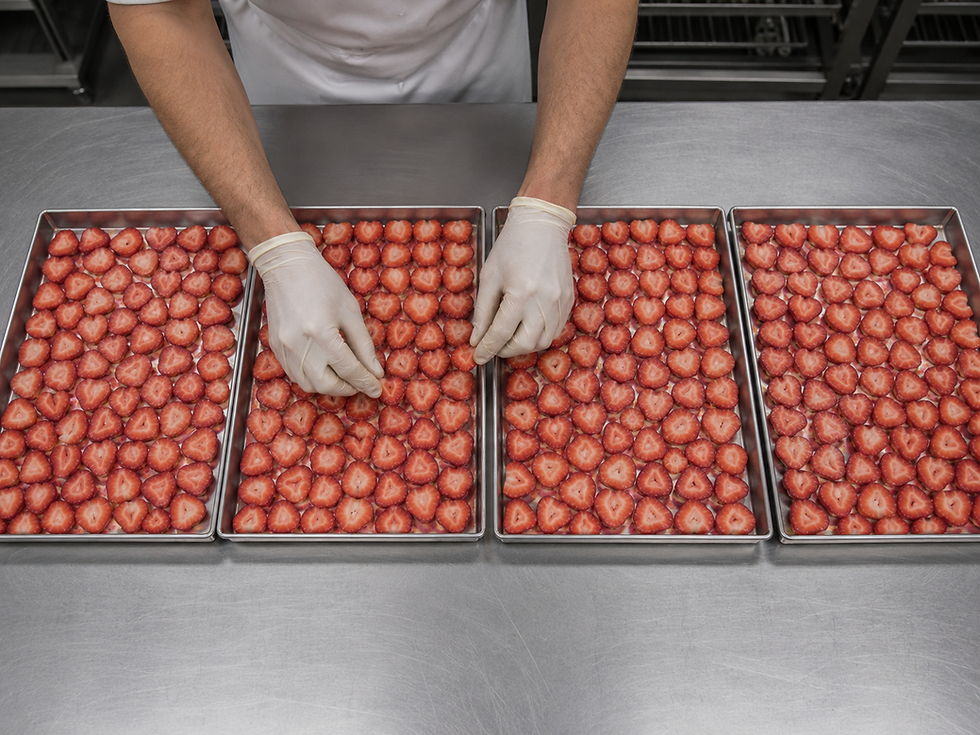
The preparation counter should be at least 2 metres wide if you plan to dry with the 5-shelf system. When working with 7 shelves, I would rather choose a counter length of 2.5–3 m, so that all product trays can be laid out next to each other after the process. Do not forget wall-mounted cabinets above the counter, where a range of tools can be stored. Lighting can also be installed underneath them, because you will need enough light during preparation as well as during inspection after the process, regardless of the time of day.
The sink should be directly connected to the preparation counter. Forget the sink you have in your kitchen, because the product trays simply will not fit into it. It is definitely worth investing in a large professional stainless steel sink, preferably equipped with a pre-rinse spray faucet.
A vacuum packaging machine is unnecessary at the beginning, unless you plan to produce meals with extremely long shelf life. Most of our users work with a simple Doypack heat sealer.
That gives us the basic setup. In the next article, we will focus separately on the smaller tools needed for food preparation, freeze drying, and subsequent packaging.